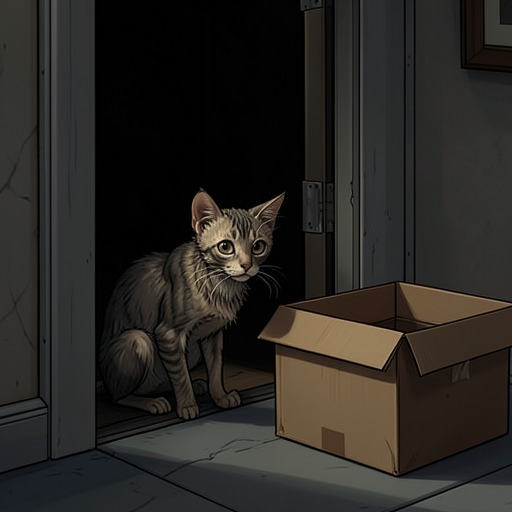
Rusty's failed chloroforming
Anne of the IslandRusty's failed chloroforming turns an attempt to remove an unwanted stray into the occasion of his adoption. The plan is prompted by practical limits, but its failure changes the girls’ decision: Anne recognizes the cat’s trust in her and refuses to let him face a second attempt. Rusty survives, becomes part of the household, and develops an attachment to Anne that defines his place in the family.
Why the Girls Decide He Cannot Stay
Rusty has been on the doorstep for days, entering whenever the door opens and taking notice of no one but Anne. Although the girls initially feed him out of compassion, his appearance improves: his eye and cheek return to normal, he is less thin, and he has begun washing his face. His persistence makes the question of keeping him harder to avoid, even as the household’s affection for him grows.
Stella argues that Rusty cannot remain because Aunt Jamesina is due the following week with The Sarah-cat. The girls cannot accommodate two cats, she says, and expects Rusty to fight with the newcomer. Her assessment is reinforced by his recent battle with the tobacco-king’s cat, whom he routed. Rusty, meanwhile, sits purring on the hearth rug with an air of meekness that contrasts with his reputation as a fighter. The mismatch between his gentle appearance at home and his aggression toward other cats makes him difficult to dismiss as merely a nuisance.
The girls agree that they must find a way to remove him, but Anne sees no easy solution: Rusty has shown little response to their cool welcome and appears determined to stay. Phil proposes chloroform as a humane method. Anne questions whether any of them knows how to use it; Phil says that she does, describing a procedure involving a morning meal, an old burlap bag, a wooden box, a two-ounce bottle of chloroform, and a heavy weight. She offers to carry it out, and Anne accepts the plan with evident doubt rather than confidence.
The Attempt and the Discovery
The chloroform is obtained, and the next morning Rusty is lured to the back porch after eating breakfast. He then climbs into Anne’s lap. That ordinary gesture reverses the emotional meaning of the plan for her: she recognizes that Rusty loves and trusts her, and can no longer regard his destruction as a practical task. She hastily hands him to Phil, says that she feels like a murderess, and leaves. Phil reassures her that he will not suffer, but Anne does not stay to watch.
The deed is carried out in the back porch, and no one approaches the place during the day. At dusk, Phil announces that Rusty must be buried. Priscilla and Stella have dug a grave in the orchard, while Anne is to accompany Phil to lift the box. Phil says that this is the part she always hates, a detail that makes clear this method is familiar to her from earlier occasions at home. The burial arrangements bring the plan to its apparent conclusion before anyone knows whether it has succeeded.
As Anne and Phil approach the porch, they hear a faint but unmistakable mew beneath the box. Anne sits down on the kitchen doorstep in shock. Phil insists that Rusty must be dead, but a second small mew confirms that he is alive. Stella appears from the doorway, wondering why the others have not come to the grave; the contrast between the ready grave and the sound under the box turns the episode’s grim expectation into absurdity. Anne answers Stella’s teasing poetic allusion with another, solemnly indicating the box, and the exchange releases the tension in laughter.
Phil decides to leave the box in place until morning. Rusty has not mewed for five minutes, and she wonders whether the sounds were a dying groan or an effect of their guilty consciences. The pause prolongs the uncertainty: the girls have heard evidence of life, yet cannot be sure what the silence means. In the morning, the box is lifted and Rusty leaps onto Anne’s shoulder, licking her face affectionately. His survival is no longer a possibility to be debated; the cat is unmistakably alive.
Anne Claims Rusty
Phil discovers a knot hole in the box and realizes that it accounts for Rusty’s survival. Her immediate conclusion is that the procedure must be repeated. Anne interrupts that logic: Rusty will not be killed again, she declares, and is now her cat. The change is decisive. The girls’ original disagreement concerned whether a second cat could be kept, but Anne’s response treats Rusty’s bond with her, and her responsibility to him, as more important than the attempt to resolve the household problem by removing him.
Stella leaves Anne to settle the practical difficulty with Aunt Jamesina and The Sarah-cat. The episode does not describe a further attempt to dispose of Rusty. Instead, it moves directly to his lasting place in the family: after this point, he is accepted as one of the household. His rescue is therefore not simply a reprieve from the box. Anne’s declaration converts an unwanted stray into a pet she openly claims, while the others accommodate that choice.
Life After the Rescue
Rusty sleeps at night on the scrubbing cushion in the back porch and lives well. By the time Aunt Jamesina arrives, he is plump, glossy, and more respectable in appearance. These details complete the contrast begun with the sickly, unwelcome cat at the door: feeding and shelter have made him comfortable, and the household has made room for him rather than proceeding with the original plan.
His acceptance does not make him sociable. Like Kipling’s cat who walks by himself, Rusty remains hostile to other cats, and one by one he defeats the aristocratic felines of Spofford Avenue. His independence is paired with a sharply selective affection: he loves Anne alone. Other people do not dare stroke him, and he responds to their approaches with an angry spit and what sounds like very improper language. Stella finds his airs intolerable, while Anne cuddles him and insists on his worth. The rescued cat thus remains formidable and difficult, but his attachment to Anne gives him a secure place in the household.
Significance of the Reversal
The episode’s central reversal comes through a small, specific piece of damage in the box: the knot hole that makes the planned death fail. Yet survival by accident does not settle Rusty’s fate. The decisive change occurs when Anne sees him climb into her lap and understands the trust involved, then later turns that recognition into a firm refusal to repeat the attempt. Her choice gives practical consequence to compassion: she takes responsibility for keeping the cat despite Stella’s concern about the arrival of The Sarah-cat.
The event also changes the tone of its own crisis. The grave is already dug, and the girls approach the box expecting to complete the burial; instead, a faint sound, uncertain silence, and Rusty’s sudden return to Anne turn fear into laughter and relief. The household’s continuing difficulties with his temper preserve the costs of the decision rather than making him an effortlessly convenient pet. Rusty is welcomed as family without ceasing to be independent, aggressive toward cats, and devoted to Anne alone.